Welcome to Beacon Hill, Boston, MA
Beacon Hill is the neighborhood most people picture when they picture Boston: brick rowhouses stacked shoulder to shoulder, gas lamps burning in daylight, a gold dome at the top of the hill. What makes it unusual isn't just that it looks this way — it's that it will keep looking this way. Massachusetts' first historic district has spent seventy years protecting its own facade, and that single fact shapes everything from what you'll pay per square foot to how long it takes to replace a window.
Here's what you should understand before you buy here.
Beacon Hill at a Glance
Roughly half a square mile in the geographic center of Boston, bounded by Boston Common, the Charles River, Cambridge Street, and Storrow Drive. Architecture is overwhelmingly Federal, Greek Revival, and Victorian brick rowhouses with wrought-iron detail. The Massachusetts State House anchors the summit; Acorn Street, Louisburg Square, and the African Meeting House are the landmarks people travel to see. Charles Street is the commercial spine — boutiques, antiques, and independent restaurants, with almost no chain retail. Over 1,100 working gas lamps still light the streets.
The practical summary: extremely walkable, extremely central, extremely regulated, and among the most expensive residential real estate in New England.
The History Behind Boston's Most Preserved Neighborhood
The hill was originally called Sentry Hill, and in 1635 the town put a beacon on its highest point to warn of approaching danger — hence the name. Back then it was part of a three-summit ridge known as the Trimountain, which survives today in the name Tremont Street.
The neighborhood as it exists was essentially a real estate development. Beginning in 1795, a syndicate called the Mount Vernon Proprietors — working with architect Charles Bulfinch — shaved the top off the hill, used the fill to extend the shoreline, and laid out residential streets on the newly graded land. Bulfinch's Massachusetts State House was completed in 1798 and set the architectural tone for everything built afterward.
The North Slope developed on a different track and matters enormously to Boston's history. Before the Civil War it was the center of the city's free Black community and a core of the abolitionist movement, with documented Underground Railroad stops and the African Meeting House, built in 1806 and the oldest surviving Black church building in the United States.
By the 1950s, postwar redevelopment was erasing historic Boston block by block — the adjacent West End was demolished almost entirely. In 1955, Beacon Hill was designated Massachusetts' first historic district. That decision is why the neighborhood still has its brickwork, shutters, and gas lamps, and why buying here comes with a rulebook.
Where Beacon Hill Is Located in Boston
Beacon Hill sits directly north of Boston Common and the Public Garden, wedged between downtown and the Charles River. Its borders are clean and easy to remember:
Cambridge Street to the north, Beacon Street along the Common to the south, Bowdoin and Somerset Streets against downtown to the east, and Storrow Drive and the Charles River Esplanade to the west.
That footprint means you're walking to the Financial District in about fifteen minutes, to Mass General in five, and to the Public Garden in two. It's one of the few Boston addresses where a car is genuinely optional.
The Flat of the Hill vs. the North and South Slopes
Locals don't talk about Beacon Hill as one place. Three sections developed separately, and the differences in price, layout, and character are real.
Section | Where It Is | What Defines It |
|---|
South Slope | Summit down to Chestnut Street, facing Boston Common | Historically the wealthiest section. Bulfinch-era Federal and Greek Revival townhouses, private parks like Louisburg Square, and cobblestone lanes including Acorn Street. Grandest scale, highest prices. |
North Slope | Pinckney Street down to Cambridge Street | Historically working-class and the heart of Boston's 19th-century free Black community. Narrower streets, more compact rowhouses, more converted multi-family buildings. The Black Heritage Trail runs through it. Generally the better value. |
Flat of the Hill | Charles Street west to Storrow Drive | Built on 19th-century landfill. Originally stables and service trades for the South Slope, now converted carriage houses and newer residences. Level ground, closest to the Esplanade and the Red Line. |
If you're weighing sections: the South Slope buys prestige and architectural drama, the North Slope buys entry, and the Flat buys convenience — including the rare possibility of parking.
Architecture: Federal and Greek Revival Rowhouses
Two styles dominate, and once you can tell them apart you can date almost any block by eye.
Federal (1790s–1830s) is the restrained one: flat brick facades, multi-pane sash windows under simple stone lintels, fanlight windows above the door, delicate wrought-iron balconies. The bow front — that gentle outward curve — was a Boston innovation designed to pull more daylight into narrow rooms.
Greek Revival (1830s–1850s) is heavier and more theatrical: granite bases and stoops, bold post-and-lintel door surrounds, recessed entries framed by columns or pilasters, thick moldings, pronounced cornices.
What this means for a buyer: interiors reflect the era they were built in. Expect original fireplaces, tall ceilings on the parlor floor, narrower stairwells, and rooms that don't conform to modern proportions. Garden-level units have lower ceilings and less light — an important thing to see in person rather than in photos.
Living on Gas-Lit Streets and Brick Sidewalks
The gas lamps are not a decorative revival. More than 1,100 city-maintained fixtures burn continuously, and the amber light they throw is the reason Beacon Hill evenings look nothing like the rest of Boston.
Sidewalks are red brick, frequently laid in herringbone, and streets like Acorn retain original river-stone cobbles that require specialized historic masonry to maintain. It's beautiful and it's uneven — worth walking in the shoes you actually own, especially in February.
The Beacon Hill Architectural Commission governs the details you might not expect: shutter colors (traditionally black or dark green), window materials, mortar tint, brass hardware, even the boot scrapers by the front doors. The consistency you're admiring is enforced.
Charles Street: Shopping, Antiques, and Dining
Charles Street runs along the western base of the hill and functions as the neighborhood's living room. It's largely free of formulaic chain retail — a genuine rarity in a downtown-adjacent corridor.
It has long been Boston's antiques district, with galleries dealing in 18th- and 19th-century American and European furniture, estate jewelry, and rare prints. Around them sit independent bookstores, home decor studios, paper goods shops, apparel boutiques, and artisan chocolatiers. Dining runs from historic taverns and European-style bistros to upscale Italian rooms, cafes, and bakeries that put tables on the sidewalk the moment weather permits.
For residents, the practical value is that daily errands — coffee, wine, flowers, dinner — happen on foot within a few blocks.
Parks and Green Space: Boston Common, the Public Garden, and the Esplanade
Three of the most significant public landscapes in the country border this neighborhood.
Boston Common sits along the southern edge. Established in 1634, it's the oldest public park in America — fifty acres of open ground, the Frog Pond for skating in winter and wading in summer, and direct access to the Freedom Trail.
Boston Public Garden, off the southwest corner, opened in 1837 as the nation's first public botanical garden. Victorian plantings, weeping willows over the lagoon, the Swan Boats, and the Make Way for Ducklings bronzes.
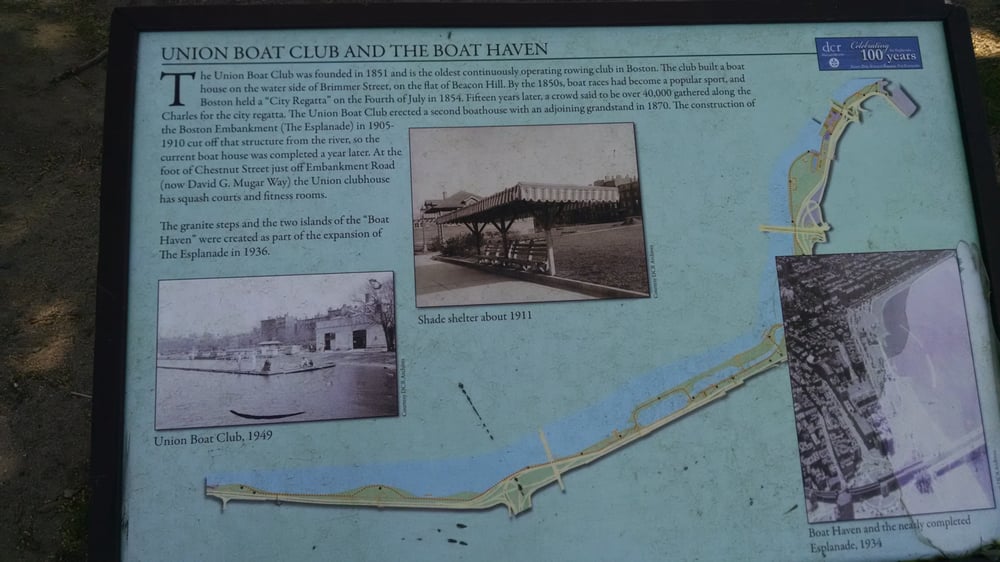
The Charles River Esplanade runs the full western border, reached by pedestrian footbridges over Storrow Drive. Miles of running and cycling paths, community sailing and kayak docks, and the Hatch Shell for summer concerts.
Functionally, Beacon Hill residents trade private yards for immediate access to three world-class parks. For most people who choose this neighborhood, that trade makes sense.
Landmarks and Historic Sites Worth Seeing
The Massachusetts State House crowns the summit — Bulfinch, 1798, its dome originally sheathed in copper from Paul Revere's foundry and now finished in 23-karat gold leaf.
Acorn Street is likely the most photographed residential lane in America: a narrow 1820s passage with authentic river-stone cobbles, gas lanterns, and Federal rowhouses. Expect tourists at golden hour.
Louisburg Square is a private park behind wrought iron, ringed by Greek Revival and Federal mansions. Louisa May Alcott lived here; so has John Kerry. It remains one of the most exclusive addresses in the city.
The African Meeting House on the North Slope, built in 1806, is the oldest surviving Black church building in the United States and a central stop on the 1.6-mile Black Heritage Trail, which links fourteen abolitionist-era sites and homes.
The Nichols House Museum, a preserved 1804 townhouse attributed to Bulfinch, is the best way to see what these interiors actually looked like in daily use.
Getting Around: Transit, Walkability, and Parking
Walking is the default. The whole neighborhood spans about half a square mile, though the grade is real — the hill earns its name, and brick and cobblestone make for uneven footing.
Four MBTA stations frame the hill: Park Street (Red and Green), Charles/MGH (Red), Government Center (Blue and Green), and Bowdoin (Blue). A useful local trick: taking the Red Line to Charles/MGH drops you on the Flat of the Hill and spares you the climb.
Rideshare works reliably along the perimeter — Beacon, Cambridge, and Charles Streets — but drivers struggle inside the interior lanes, where one-way turns and tight clearances create genuine problems. Set pickups on the edges.
Cars are the weak point. On-street parking is almost entirely resident-permit only. Visitors should plan on the Boston Common Garage, with its entrance on Charles Street, or garages in the West End and Government Center. If you own a car and need to keep it here, read the next section carefully.
Schools Serving Beacon Hill
The neighborhood has a concentration of independent early-grade schools within walking distance. The Advent School on Brimmer Street serves Pre-K through 6 with a progressive, project-based approach. Park Street School, also on Brimmer and Park, offers continuous Pre-K through 6 grounded in a Christian worldview. Torit Montessori on Cambridge Street runs multi-language Montessori instruction from infancy through grade 6, and Beacon Hill Nursery School on Joy Street handles preschool and early childhood.
Public school families participate in the citywide Boston Public Schools assignment system rather than a fixed neighborhood zone — nearby options have included Josiah Quincy Elementary in Chinatown and the Warren-Prescott School in Charlestown. For grades 7–12, the exam schools are the draw: Boston Latin School, Boston Latin Academy, and the John D. O'Bryant School of Math & Science, all admission-based.
Because BPS assignment policies change, I'd always recommend confirming current options against your specific address before making a decision on that basis.
Beacon Hill Real Estate: Housing Types and What to Expect
Beacon Hill is a supply-constrained market by law. Historic protections make new density essentially impossible, so inventory is fixed while demand from downtown professionals, Mass General staff, and luxury buyers is not. That imbalance is the central fact of pricing here.
Housing Type | What It Is | Typical Range |
|---|
Condominiums | Subdivided 19th-century townhouses, from garden-level studios to full floor-through units | $600,000 – $2.5M+ |
Single-Family Townhouses | Full 4- to 6-story Federal or Greek Revival rowhouses with original fireplaces, high ceilings, courtyards, roof decks | $4M – $12M+, exceeding $15M on squares like Louisburg |
Carriage Houses | Lower-profile Flat of the Hill buildings originally built for horses and carriages, converted to single-family | $3M – $7M+ |
Price per square foot commonly runs $1,200 to $1,600 and above. A few things I make sure clients understand before they write an offer:
Exterior work requires commission approval, and compliant materials — custom wood-framed windows, real slate roofing — cost multiples of standard replacements. Deeded off-street parking is genuinely rare and trades between roughly $250,000 and $400,000+ when sold on its own. And elevators are uncommon in smaller rowhouses, so walk-ups, narrow stairwells, and irregular room layouts are the norm rather than the exception.
None of that is a reason not to buy here. It's a reason to buy here with your eyes open.
Historic District Guidelines and What They Mean for Homeowners
The Beacon Hill Architectural Commission holds jurisdiction over any exterior change visible from a public way — and "public way" is defined broadly, including alleys, Boston Common, the Esplanade, and even bridges.
Interior work is unrestricted. Renovate the kitchen, move walls, redo the baths; the commission has no say. Anything outside does: paint, light fixtures, doors, masonry, roof decks. Those require a Certificate of Appropriateness before work begins.
Replacement windows must match historic true-divided-lite patterns in wood frames with clear, untinted glass and correct muntin profiles — which rules out vinyl and modern low-E reflective coatings. Brick repointing requires mortar matched to the original color, sand texture, and joint thickness, and sandblasting is banned outright, so you'll need a preservation specialist rather than a general masonry crew. Mechanical equipment — condensers, heat pumps, vents, satellite dishes, skylights — cannot be visible from public paths, which usually means concealment behind rear parapets and higher rigging costs.
Approvals expire after two years, unpermitted exterior work carries fines up to $1,000 per day plus mandatory removal, and reviews happen at monthly public meetings. Build that calendar into any renovation timeline.
Is Beacon Hill the Right Fit for You?
This neighborhood rewards you if you want character and walkability above all else — gas lamps, brick, independent shops on Charles Street, the Common and the T at your doorstep. It rewards you if you value the permanence of the setting, because historic protection means the view from your window is legally insulated from change, and that scarcity has held values up through multiple cycles. And it rewards you if you work downtown, in the Financial District, or at Mass General and would rather walk than drive.
Look elsewhere if you want turnkey modern living: open floor plans, attached garage parking, elevator access, a private yard. Look elsewhere if permit timelines and custom-material costs will wear you down. And be honest about mobility — steep brick sidewalks, cobblestones, and long flights of entry stairs are a daily reality, not an occasional inconvenience.
Most buyers who fall for Beacon Hill know it within one walk up Chestnut Street. The work after that is matching the right section, the right building, and the right expectations.
Work With Colin Bayley
I've spent my career in Boston's most sought-after neighborhoods — Beacon Hill, Back Bay, the South End, the Seaport, plus Cambridge, Brookline, and Newton — representing buyers, sellers, developers, and investors with the same attention regardless of price point. In a market this constrained, the difference between a good outcome and a frustrating one usually comes down to access and judgment: knowing which townhouses are quietly available before they list, which buildings have commission history worth reviewing, and which garden-level units are a bargain versus a compromise.
If you're considering Beacon Hill, I'm happy to walk the slopes with you and talk honestly about what fits. Reach me at (978) 761-0240 or [email protected], or visit my office at 126 Newbury St, Suite 2, Boston, MA 02116.